A broken light in the stairwell, a door that doesn't close properly, leaves in front of the entrance and somewhere there's been […]

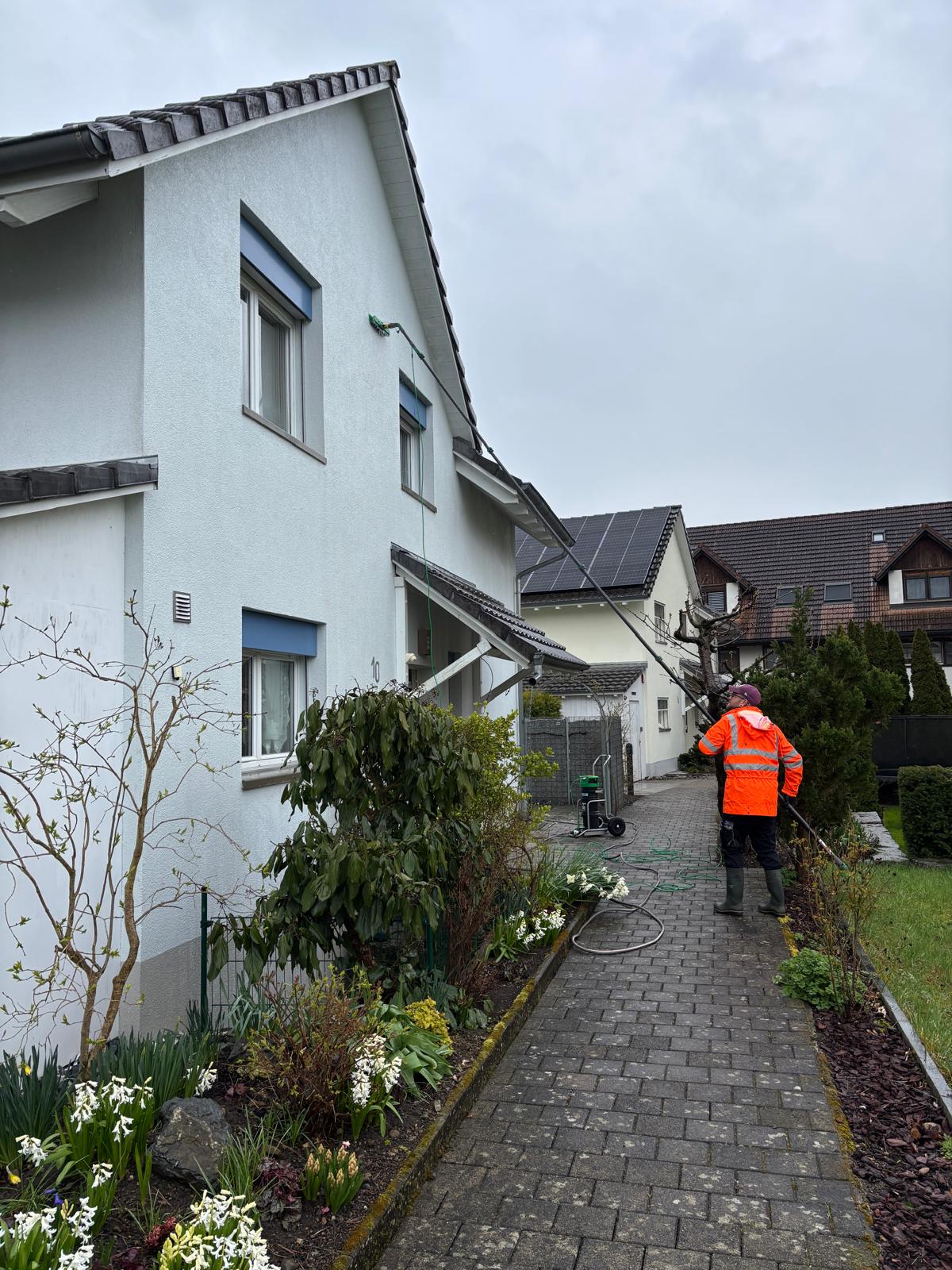
The facade is greenish, grey or stained and the whole building suddenly looks a few years older.
So repaint it?
Not necessarily.
Because a facade can look very dirty even though the actual paintwork or surface is still in good condition.
Dust, pollen, environmental grime, algae and other deposits leave clear marks over time.
In such cases, a professional facade cleaning can already make an astonishing difference.
Crucial, however, is finding out first, what sits on the façade – and what lies beneath it.
A façade is exposed to all weathers all year round.
Rain, moisture, dust, pollen and other environmental factors leave their mark over time.
Depending on the location of the building, additional loads may apply.
For example:
That is why even two sides of the same building can look completely different.
The sunny side still looks clean, while a green veil is already spreading on the shady side.
Green or dark discoloration on a facade can have various causes.
Particularly damp areas provide good conditions for algae and other microbiological growths.
In addition, dust, pollen and other pollutants accumulate on the surface.
Therefore, what is important is:
Not every stain is treated the same.
Before cleaning, it should be clarified what kind of contamination it is and what surface lies beneath it.
For a rendered façade may require a different treatment than natural stone, concrete or metal.
If a façade looks dirty, it doesn't automatically mean that it needs to be renovated.
If the surface is fundamentally still intact and mainly dirty, professional cleaning can significantly improve the overall appearance.
The situation is different if damage is already present.
For example:
Cleaning can remove dirt.
However, that doesn't suddenly make a damaged façade good as new.
Therefore, the condition of the surface should always be assessed prior to cleaning.
The pressure washer is probably the device that most people think of first when it comes to facade cleaning.
And yes: high pressure can be very effective on suitable surfaces.
However:
More pressure doesn't automatically mean more cleanliness.
Depending on the facade material, excessive pressure can damage the surface.
Water can erode material, attack coatings or get into areas where moisture has no place.
That is why high pressure is only one possible cleaning method – not automatically the right one.
Professional facade cleaning means adapting pressure, temperature, cleaning agents and working method to the respective surface.
Sometimes it takes a lot of grunt.
Sometimes less is definitely more.
Not all facades are the same.
On buildings we find, among other things:
These materials react differently to water, chemicals, temperature and mechanical stress.
A cleaning agent that works without any issues on a durable surface can cause discoloration or damage to a delicate façade.
Therefore, one of our favourite rules also applies here:
First know the material – then choose the cleaning agent.
Not the other way round.
For delicate or unknown surfaces, it can be useful to test a small area first.
This is how it can be assessed:
How does the surface react?
Is the contamination clearing up?
Does the colour change?
Does the coating remain intact?
Especially with large facades, a small test area can later prevent a big surprise.
And surprises are nice at birthdays.
Not so much with facades.
If a façade keeps turning green after a short time, it is worth taking a closer look.
For then the contamination may simply be the visible result of another problem.
For example, an area can remain damp for a particularly long time or be heavily shaded.
The cleaning removes the existing deposit.
However, it does not automatically change the conditions that gave rise to it.
Therefore, in the case of a severe recurring infestation, not only should the question be asked:
«How do we get rid of this?»
But also:
«Why does it keep happening?»
There is no sensible flat-rate rhythm for that.
A facade on a busy road can get dirty much faster than a building in a quiet location.
Weather side, shade, vegetation and facade material also play a role.
That is why we think very little of statements such as:
«A facade must be cleaned every three years.»
It is better to assess the actual condition.
Light soiling is often easier to treat than deposits that have built up over many years.
Cleaning doesn't necessarily have to stop at the house wall.
Depending on the property, adjacent surfaces may also be soiled.
For example:
Which method is suitable also depends on the respective material and its condition in this case too.
Particularly when pressure washing, you should not just use the exact same setting everywhere.
Before having a dirty facade repainted, first check, whether the coating really is the problem – or mainly the dirt on it.
A professionally carried out cleaning can already make a big visual difference to an otherwise sound facade.
Equally important:
Do not start immediately with the strongest cleaning agent and maximum water pressure.
A good facade cleaning works as strong as necessary and as gentle as possible.
This protects the surface – and usually your sanity as well.
A dirty facade does not automatically have to be repainted.
If the surface and coating are still intact, professional cleaning can remove dust, environmental grime and various deposits, and significantly improve the appearance.
Which method is suitable for this depends on the contamination, material and condition of the façade.
High pressure can be an effective tool in this regard – but only where it genuinely belongs.
Or in short:
A facade doesn't always need a fresh coat of paint. Sometimes it just needs a really good clean.
The Putzvogel GmbH carries out façade and high-pressure cleaning, and tailors the cleaning method to the specific building and existing surfaces.
We would be happy to take a look at your facade and provide you with a no-obligation quote.
A broken light in the stairwell, a door that doesn't close properly, leaves in front of the entrance and somewhere there's been […]
Clean is good. But sometimes clean alone isn't enough. Floors and surfaces are subjected to daily wear and tear: from shoes, moisture, dirt, cleaning agents [...]
A new build is finished as soon as the last tradesperson has packed up their tools? If only. On a construction site, despite careful […]

Baden | Schlieren | Wettingen | Urdorf | Altstetten | Bremgarten | Berikon | Geroldswil | Oberengstringen