A broken light in the stairwell, a door that doesn't close properly, leaves in front of the entrance and somewhere there's been […]

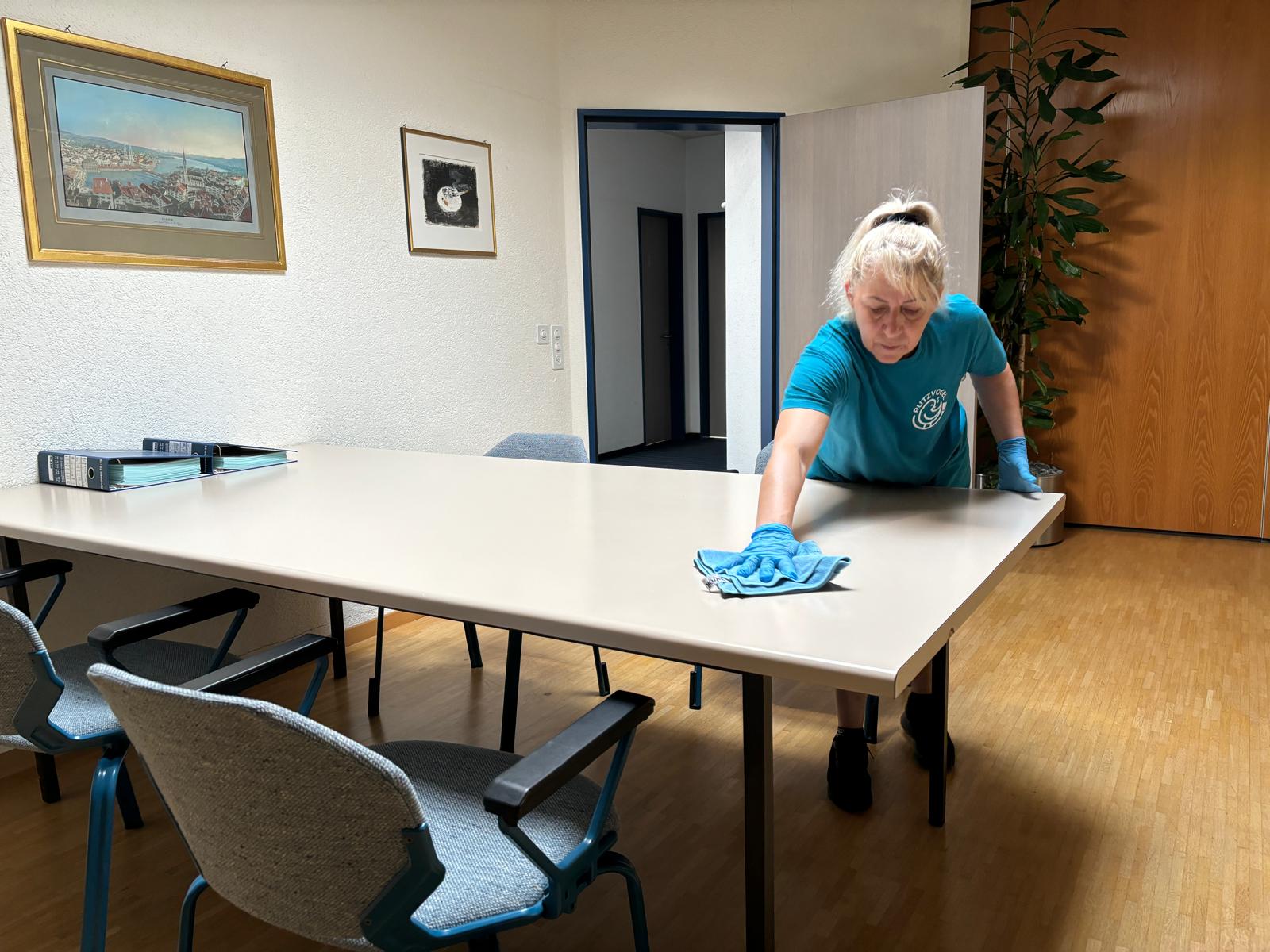
Once a week? Three times? Or every evening?
Whoever is responsible for cleaning an office will sooner or later ask themselves this exact question: How often should cleaning actually be done?
The answer is less spectacular than hoped: it depends.
Because an office with five members of staff and little customer traffic has completely different requirements to an open-plan office where fifty people come and go every day.
Professional office cleaning therefore doesn't simply mean cleaning as often as possible. Much more important is, cleaning the right areas in the right rhythm.
And this is precisely where the requirements specification comes in.
A flat rate rarely works for office cleaning.
What is decisive is how the building is actually used.
For example, a meeting room that is used twice a week does not need to be cleaned as often as a toilet that is used daily by numerous people.
The same applies to workspaces, entrance areas, kitchens or stairwells.
The more heavily an area is used, the more frequently it should be inspected and, if necessary, cleaned.
The question therefore is not only:
«How often does the cleaning company come?»
But rather:
«What work is carried out how often?»
That sounds similar - but in practice it makes a big difference.
Let's take a look at a typical office.
The entrance area is the business card of the company. Dirt from outside, dust, raindrops or salt in winter quickly become visible here.
By contrast, dust, waste paper and standard foot traffic are the main things generated in the actual office spaces.
And then there is the kitchen and sanitary facilities.
These areas are heavily used and generally require more attention than a seldom-used archive or meeting room.
Therefore, a good cleaning concept does not simply treat the entire surface the same.
It takes into account the actual usage of each area.
Anyone who works in an office knows it:
In the morning the kitchen is clean.
By ten o'clock, the coffee machine apparently already had a little war behind it.
Kitchens and communal areas are classic examples of why a rigid cleaning schedule is not always enough.
Sanitary facilities must also be considered depending on the number of employees and usage.
For a small business, cleaning at longer intervals may be sufficient. With many employees or heavy customer traffic, significantly more frequent cleaning may be necessary.
Exactly such differences should be taken into account by a good cleaning plan.
More people usually also mean more usage.
More footsteps on the floor, more waste, more used tableware and more wear and tear on the sanitary facilities.
However, the same applies here:
The number of employees alone is not sufficient for planning.
An office with twenty people, who mainly sit at their workstations, can have different requirements to a business with ten employees and constant public footfall.
That is why, during professional planning, we always look at the entire property and how it is used.
That depends on the agreed-upon order.
Typical tasks of routine ongoing cleaning can include, for example, vacuuming or damp cleaning floors, cleaning sanitary facilities, emptying waste bins, and cleaning kitchens and frequently used surfaces.
Other tasks, on the other hand, do not need to be carried out every time they are used.
Windows, carpets, doors, skirting boards, radiators or hard-to-reach areas can, for example, be scheduled at longer intervals.
That is precisely why the statement «Please just clean the office» a bit too imprecise for a professional clean.
A specifications document records, which cleaning tasks are carried out when.
That sounds like paperwork at first.
In reality, it is one of the most important tools for effective routine cleaning.
Because without a clear agreement, «clean» can mean something completely different to the customer than it does to the cleaning company.
For example, a good requirements specification can stipulate:
This ensures both parties know exactly what has been agreed.
And if something is not right, it is much easier to assess whether work was forgotten or was not part of the order at all.
Of course, theoretically one could clean every door, every skirting board, every window and every radiator during every assignment.
However, that wouldn't make sense in most offices.
Professional cleaning also means deploying working time where it is needed.
A toilet used every day needs more attention than the top of a cupboard in the boardroom.
An entrance area in winter may require more maintenance than in midsummer.
And a rarely used area does not automatically need to be cleaned just as often as a heavily used workstation.
Good cleaning is therefore not as much cleaning as possible – but the right cleaning at the right time.
Even with well-planned routine cleaning, there are tasks that are not carried out every time.
Over time, dirt can therefore build up in certain places.
This is where the deep clean comes in.
It goes deeper and takes care of areas or dirt that are not continuously intensively treated during the normal cleaning routine.
Routine cleaning and deep cleaning are therefore not opposites.
They complement each other.
Routine cleaning keeps the property clean on a day-to-day basis. Periodically, deep cleaning ensures that even deeper-lying or hard-to-reach areas are thoroughly treated again.
A cleaning plan is not set in stone for all eternity.
Businesses change.
Perhaps twice as many people are suddenly working in the office. A new breakout room is added. Working hours change or the company welcomes significantly more customers than before.
Then the cleaning should also be adapted.
Therefore, it makes sense to review the requirements specification together from time to time.
Are the intervals still correct?
Are there any areas that are cleaned too often?
Or areas that actually require more attention?
Sometimes a small adjustment can achieve significantly more.
Plan an office clean not in terms of the time required, but in terms of the desired outcome.
So the question should not be first:
«How many hours of cleaning do we need?»
Rather:
«What should our office look like and what work is necessary for this?»
Only after that are sensible cleaning intervals determined.
This creates a concept that suits the property – instead of a generic cleaning schedule that looks the same everywhere.
How often an office should be cleaned depends on the size, usage, number of employees, customer traffic and the individual areas of the building.
Sanitary facilities and kitchens may require different intervals than office spaces, meeting rooms or rarely used auxiliary rooms.
A tailored requirements specification provides clarity on this.
It specifies which work is carried out and when, and prevents the client and the cleaning company from having different expectations of the job.
Or in short:
Good office cleaning does not begin with a cleaning rag – but with a sensible plan.
The Putzvogel GmbH undertakes one-off and regularly recurring maintenance cleaning for offices, surgeries, stairwells and other commercial properties.
We would be happy to create a for your property tailored requirements specification and a no-obligation quote.
A broken light in the stairwell, a door that doesn't close properly, leaves in front of the entrance and somewhere there's been […]
Clean is good. But sometimes clean alone isn't enough. Floors and surfaces are subjected to daily wear and tear: from shoes, moisture, dirt, cleaning agents [...]
The façade is greenish, grey or stained and the whole building suddenly looks a few years older. So, repaint? […]

Baden | Schlieren | Wettingen | Urdorf | Altstetten | Bremgarten | Berikon | Geroldswil | Oberengstringen