A broken light in the stairwell, a door that doesn't close properly, leaves in front of the entrance and somewhere there's been […]

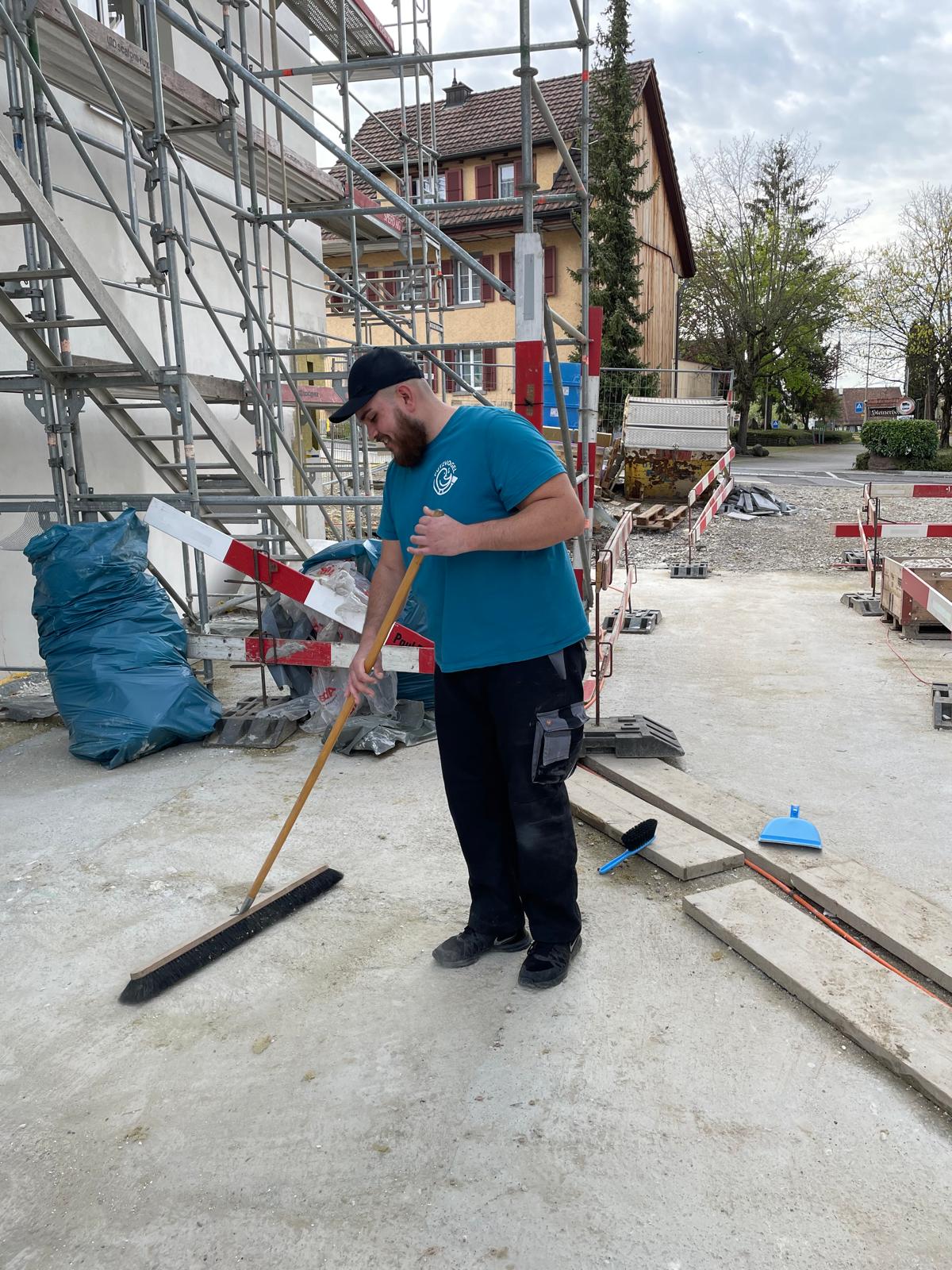
Is a new build finished as soon as the last tradesperson has packed up their tools?
I wish.
Despite careful work, dust, packaging material, protective films, adhesive residue, paint splatters and plenty of fine construction dirt remain on a construction site.
Before a building is truly ready for occupancy, it therefore usually requires one more important step: builder's clean.
However, builders' cleans are not all the same. Depending on the construction phase, a distinction is made between, among others, Rough builders' clean, intermediate clean and final builders' clean.
Rough builder's cleans take place during or towards the end of the construction work.
This primarily removes coarse dirt.
These can include, for example:
The goal is not yet perfect cleanliness.
Rather, the construction site is to become clear and walkable again.
This is especially important on larger construction projects to ensure that subsequent work is not constantly hindered by lying-around materials and mess.
Or in other words:
Before thorough cleaning can take place, space must be cleared first.
For longer construction or renovation projects, cleaning only at the very end is often not enough.
Because on construction sites, dust has a remarkable property:
He really finds his way anywhere.
In door frames, on window sills, in stairwells, on already finished floors, and gladly also in rooms where work has actually long since ceased.
An intermediate clean can therefore be useful to regularly reduce dirt during the construction phase.
This makes subsequent work easier and prevents dirt from being carried further through the building.
Especially during refurbishments in partially occupied buildings, an intermediate clean can be important.
The final builders' clean is the last major cleaning step before handover or occupation.
Now it is no longer about coarse construction waste.
Now we are getting into the details.
Depending on the property, the following areas can be cleaned, amongst others:
In addition, typical construction residue is removed, as far as this is materially possible.
This includes, for example, adhesive residue, labels, fine construction dust or other residues from the construction phase.
The goal is a clean and ready-to-move-in property.
Construction dust is fine.
Very good.
And precisely for that reason, it spreads throughout the entire building.
A surface can look clean at first glance and still be covered in a fine layer of dust.
Construction dust is particularly common:
That is why, during a builders' clean, it is not enough just to quickly vacuum through.
The many small areas often make up a large part of the work.
On a construction site, many different materials come together.
For example:
And every material reacts differently to cleaning agents and mechanical processing.
A product or tool that works without any issues on a robust surface can cause damage to a delicate surface.
That is why the following applies to builders' cleans:
First identify the material, then choose the method.
Not the other way round.
Especially after construction and renovation work, adhesive residue, labels and paint splatters are not uncommon.
However, care is needed here.
An aggressive cleaner or an unsuitable blade might well remove the stain – but in the worst case, along with the surface underneath.
Therefore, it should first be checked:
What is the pollution?
What surface is underneath?
Which cleaning method is suitable for this?
For delicate materials, a cautious test in an inconspicuous spot is always worthwhile.
Builder's cleans do not only take place right at the very end.
Even during the construction phase, order and cleanliness can make a big difference.
If floors and work areas are not constantly covered in dust and leftover materials, subsequent trades can work more efficiently.
Furthermore, damage and defects are easier to spot on clean surfaces.
Therefore, a clean working environment is not just a matter of appearance.
It can also make the processes on the construction site easier.
With a new build, conditions are usually different than with a renovation.
During renovations, new building components meet existing surfaces.
Perhaps only part of the building will be renovated while other areas continue to be used.
This creates additional requirements.
For example, dust must be contained more effectively, and existing materials must be protected and cleaned with particular care.
Therefore, builders' cleans should always be tailored to the respective project.
It is best not to wait until the handover of the keys the next morning.
For larger projects, it is worth planning the cleaning into the construction schedule early on.
This is how it can be clarified:
Good planning prevents freshly cleaned rooms from being tracked over by dusty work boots five minutes later.
Which is known to happen on construction sites.
Before the final construction cleaning, it should be clear that, which work has actually been completed.
If there is still drilling, sanding or sawing going on, dust will be created again.
That is why it is worth coordinating cleaning and the construction schedule properly.
For larger projects, a site visit is also advisable.
This allows pollution, materials, accessibility and required equipment to be assessed prior to use.
This ensures realistic planning and prevents unnecessary surprises.
Professional after-builders cleaning involves significantly more than just vacuuming and mopping the floor once.
The builders' clean removes coarse residue and creates order.
The Interim clean reduces dirt and dust during the construction phase.
The Builders clean ultimately ensures that a building site becomes a clean and ready-to-occupy building.
What is crucial here is not only the right equipment and cleaning agents, but above all experience and knowledge of the materials.
Or in short:
The builders finish constructing the building – the builders' clean ensures that people are happy to enter it afterwards.
The Putzvogel GmbH undertakes builders' cleans for new builds and renovations, and coordinates the cleaning schedule with your project and construction workflow.
We would be happy to take a look at your property and provide you with a no-obligation quote.
A broken light in the stairwell, a door that doesn't close properly, leaves in front of the entrance and somewhere there's been […]
Clean is good. But sometimes clean alone isn't enough. Floors and surfaces are subjected to daily wear and tear: from shoes, moisture, dirt, cleaning agents [...]
The façade is greenish, grey or stained and the whole building suddenly looks a few years older. So, repaint? […]

Baden | Schlieren | Wettingen | Urdorf | Altstetten | Bremgarten | Berikon | Geroldswil | Oberengstringen